
Competence Center – Circular Solutions
UGC Group - European Expert Partner for Design for Recycling and Certification
We evaluate, optimize, document, and certify packaging in accordance with the requirements of the PPWR and the circular economy.
UGC Circular Solution supports companies throughout the entire process—from the initial packaging assessment through Design for Recycling and technical documentation to independent testing and certification.
Our Core Services
Developing and Optimizing Packaging for Recycling
Evaluate packaging and materials from a technical perspective
Prepare for exams and coordinate certifications
Identify Requirements and Implement Them in Compliance with Regulations
Prepare the Technical Dossier and Declaration of Conformity
Establish Consumer Guidelines and Disposal Procedures
1 Design for Recycling
1.1 Packaging Analysis
- Material and Layer Structure
- Packaging Components
- Closures and Labels
- Adhesives and Printing Inks
- Barriers and Coatings
1.2 Packaging Optimization
- Reduce the use of problematic materials
- Developing single-material solutions
- Optimize Material Combinations
- Improve separability
- Choose alternatives that are suitable for recycling
1.3 Newly Developed, Recyclable
- Packaging Concepts
- Material Selection
- Supplier Coordination
- Testing and Industrialization Support
2 Assessment of Recyclability
2.1 Preliminary Technical Assessment
- Initial assessment of recyclability
- Identification of Critical Components
- Identification of Missing Documentation
- Recommendations for Necessary Improvements
2.2 Material Evaluation
- Paper and Cardboard
- Plastic
- Glass
- Metal and Aluminum
- Composite Materials
- multi-piece packaging
2.3 National and European Requirements
- PPWR Recycling Classes
- German minimum standard
- National Collection and Recycling Channels
- Sorting and Recycling Infrastructure
- “Recycled at Scale”
2.4 Packaging Portfolio
- Evaluation of Complete Product Lines
- Prioritization Based on Need for Action
- Packaging and Variant Matrix
- Optimization Roadmap
3 Testing & Certification
3.1 Preparing for Certification
- Review technical documentation
- Compile material data
- Determine the scope of the audit
- Identify missing documentation
3.2 Recycling Tests
- Select appropriate test methods
- Coordinate laboratory tests
- Provide samples and packaging samples
- Interpret test results from a technical perspective
3.3 Independent Certification
- Project Coordination with CIRCPACK GmbH
- Support for the Certification Process
- Coordination of Technical Inquiries
- Incorporation of the Results into the PPWR Documentation
- Important Note:
UGC provides consulting, preparation, and project coordination. Independent testing and certification are performed by CIRCPACK GmbH.
4 PPWR Compliance
4.1 PPWR Gap Analysis
- Rate the current packaging
- Identify Discrepancies
- Prioritize Areas for Action
- Develop an implementation plan
4.2 Conformity Requirements
- Recyclability
- Minimizing Packaging
- Fabric Restrictions
- Recycled content
- Reuse
- Labeling
4.3 PPWR Roadmap
- individual packages
- Packaging Families
- Complete portfolios
- Supplier and Documentation Management
- time-based prioritization
4.4 EU Delegates
- EPR Authorized Representatives
- Conformity Authorized Representatives
- country-specific requirements
- Registration and Responsibilities
- Solutions for Foreign Companies
5 Technical Documentation
5.1 Technical Dossier
- Packaging Description
- Material Specifications
- Layer and Component Structure
- Test Reports
- Recyclability Assessment
- Technical Documentation
5.2 Declaration of Conformity
- PPWR Declaration of Conformity
- supporting documentation
- Responsibilities
- Version and Revision Status
5.3 Design-for-Recycling Documentation
- Basis for Evaluation
- Choice of Material
- Optimization Measures
- Expected recycling class
- remaining restrictions
5.4 Document Management
- Supplier References
- Test Reports and Certificates
- Updates in the Event of Material Changes
- Audit-compliant version control
6 Labeling & Disposal Instructions
6.1 Material Identification
- Material Codes
- Main Material
- Individual components
- Multi-component packaging
6.2 Disposal Instructions
- rated total current
- Separation Instructions
- national characteristics
- Clear and understandable consumer information
6.3 European Labeling
- Harmonized PPWR labeling
- National transitional requirements
- multilingual implementation
- digital media
6.4 Trade and Consumers
- Retail Versions
- Consumer Information
- QR Code and Digital Information
- Coordination with Brands and Retailers
From Packaging to Certification
UGC combines packaging development, design for recycling, PPWR compliance, and certification support into a coordinated process.
PPWR Overview – Circular Economy & Deadlines
The new EU Regulation on Packaging and Packaging Waste (PPWR) fundamentally changes the requirements for packaging throughout its entire life cycle. Going forward, companies will be required to consistently design packaging in accordance with the principles of the circular economy, comply with regulatory requirements, and meet mandatory deadlines.
We help companies assess regulatory requirements early on, develop implementation strategies, and ensure their packaging is future-proof—from material selection and design for recycling to recyclability, all the way through compliance with all relevant deadlines and reporting requirements.
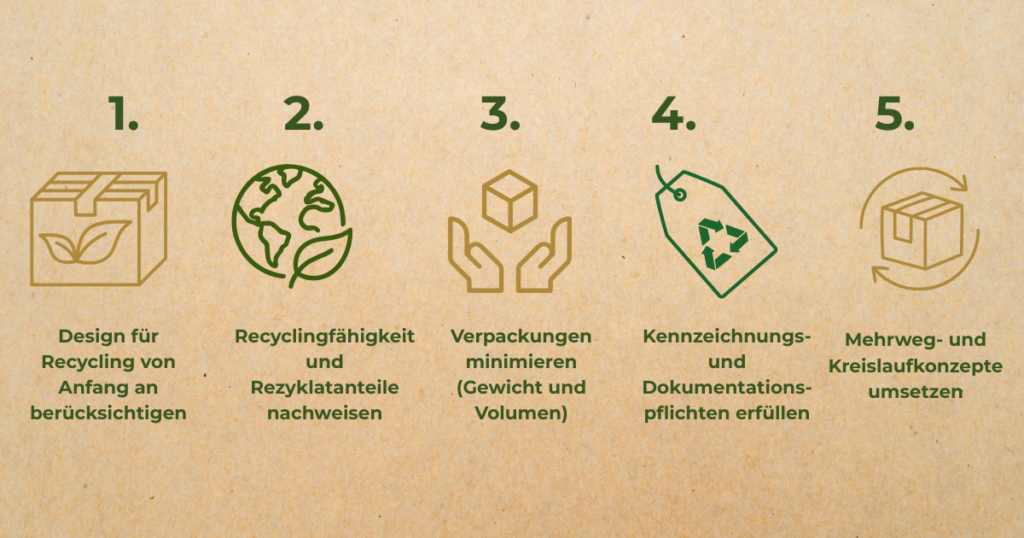
The 5 Most Important Responsibilities for Businesses
PPWR Overview
Article 3 Definitions
Art. 3 / Art. 3.37 Design for Recycling
Packaging (including all of its components) must be designed so that it can be recycled using existing collection, sorting, and recycling systems that are already functioning effectively in practice.
New requirements regarding the recyclability of packaging, supported by harmonized guidelines for design for recycling, have transformed the status quo from a recommendation to a requirement. These new requirements will be specified in subsequent delegated acts.
Art. 3.39 Large-Scale Recycling
One of the most important issues in the new PPWR—namely, the criteria for comprehensive EU-wide packaging recycling—has not yet been fully resolved. However, the EU has set an overarching goal that is to be supplemented by subsequent legislative acts.
Large-scale recycling refers to the separate collection, sorting, and recycling of packaging waste using existing facilities and best practices. This ensures that, across the European Union, at least 30% of wood packaging and 55% of packaging made from other materials are recycled annually. Packaging waste exported from the EU for recycling is also included, provided it meets certain requirements.
Art. 3.24 Composite Packaging
The exact definition of composite packaging has a significant impact on the requirements that its components must meet under the new PPWR. As a general rule, components that account for less than 5% of the packaging’s total mass are exempt from certain requirements, such as plastic taxes.
Packaging units consisting of two or more different materials that are firmly bonded together and cannot be separated by hand, thereby forming a single, uniform article. Excluded from this definition are materials that account for only a minor portion of the packaging (up to 5% of its total weight), as well as labels, lacquers, paints, inks, adhesives, and varnishes.
Art. 3.46 Innovative Packaging
Innovative packaging has become an important concept under the PPWR, as these formats are largely exempt from the same recycling requirements as conventional packaging formats. The EU has permitted this to ensure that innovation remains commonplace in Europe.
Packaging made from new materials that significantly improve one or more of its functions—such as containing, protecting, handling, or delivering products—while also offering clear environmental benefits. This does not include packaging that has merely been modified from existing designs to enhance the product’s image or marketing.
Innovative packaging is largely exempt from the PPWR requirements.
3.1 Packaging – Tea and Coffee Units
The definition of packaging has been clarified by the PPWR. As a result, a significantly wider range of items are now considered packaging and are therefore subject to the PPWR. This also applies to coffee capsules, which were previously exempt.
“Packaging” refers to any item—regardless of material—that a company uses to package, protect, handle, deliver, or present products to another company or to the end consumer. Packaging can vary in design depending on its function, material, and design.
This includes:
Permeable tea, coffee, or other beverage bags, or soft single-serving containers that contain tea, coffee, or other beverages and are intended to be used and discarded along with the product they contain.
Non-permeable single-serving containers for tea, coffee, or other beverages that are intended for use in a machine and are used and disposed of along with the product.
Art. 3.50/51 Compostable Packaging
The PPWR aims to formalize waste streams for compostable materials while ensuring that they do not negatively impact the more common and effective material recycling streams.
“Compostable packaging” refers to packaging materials that decompose (biodegrade) only under controlled industrial conditions. Additional treatments, such as physical processing or anaerobic digestion (decomposition in the absence of oxygen), may be required for complete decomposition. Ultimately, they are converted into carbon dioxide (or methane, if oxygen is absent), mineral salts, biomass, and water.
“Home-compostable packaging” refers to packaging that is biodegradable in normal, uncontrolled environments—such as a home compost pile. Individuals can compost this packaging at home to produce compost for their own use without the need for special industrial facilities or conditions.
Compostable packaging must not interfere with separate waste collection or with the composting and anaerobic digestion processes.
Art. 6 Recyclable Packaging (Recycling Performance Grade & Recycling at Scale)
Art. 6 Recyclable Packaging (Recycling Performance Grade & Recycling at Scale)
Article 6 of the EU Regulation on the Production and Recycling of Raw Materials (PPWR)—arguably the most important article—sets forth requirements regarding recycling performance classes and large-scale recycling. It includes considerations regarding the development of appropriate methods, data collection, and the impact of performance classes on extended producer responsibility (EPR) fees.
Important Dates:
Starting in 2028, the requirements for the recyclability performance grade will take effect, with a compliance deadline of 2030.
Starting in 2031, the requirements for recyclability at scale will apply, with a compliance deadline in 2035.
January 1, 2028: Deadline for various delegated acts establishing the methodology for the recyclability performance grade.
January 1, 2030: Deadline for various implementing acts establishing the methodology for recyclability at scale.
Art. 7 Minimum Percentage of Recycled Content in Plastic Packaging
Art. 7: Minimum Percentage of Recycled Material in Plastic Packaging
Building on the specific requirements previously established in the Single-Use Plastics Directive, Article 7 expands the minimum requirements for the recycling content to four primary categories of plastic packaging.
The requirements outlined in the article are as follows:
30% (50%) for PET packaging intended for contact with food, excluding single-use beverage bottles.
10% (25%) for food-contact packaging made of other plastics, excluding single-use beverage bottles.
30% (65%) for single-use plastic beverage bottles.
35% (65%) for other types of plastic packaging.
The figures in parentheses indicate the requirements for the year 2040.
Although the regulations include provisions that allow chemical recycling to contribute to these requirements, numerous procedures and methods must first be established at various levels of EU legislation.
Important Dates:
January 1, 2030: Deadline for compliance with the first minimum requirements for the recycling rate of packaging.
January 1, 2040: Deadline for meeting the second, higher minimum targets for the recycling rate of packaging.
Art. 9 Compostable Packaging
Article 9: Compostable Packaging
The PPWR is targeting compostable packaging more directly than ever before, with the goal of formalizing waste streams for compostable materials while ensuring that they do not have a negative impact on more established material recycling streams.
Important Dates:
In 2027, the development of new, harmonized compostability standards will begin.
In 2029, compostable packaging placed on the market must meet requirements regarding collection, sorting, and recycling. Member States may also mandate the use of certain types of compostable packaging.
Article 10: Minimization of Packaging
Art. 10: Minimizing Packaging
In line with broader requirements to reduce packaging waste, the PPWR targets unnecessary packaging. This refers to packaging formats that use an excessive amount of material not necessary for their function, or that are designed in a way that increases the perceived volume in a manner that is inconvenient for consumers.
Important Dates:
In 2028: The development of new, harmonized minimization standards begins.
January 1, 2030: Packaging must be designed so that weight and volume are reduced to the absolute minimum, taking into account shape and material.
Article 11: Reusable Packaging
Article 11: Reusable Packaging
To achieve the stringent objectives set forth in Article 29, Article 10 establishes the basis for standard requirements for reusable packaging. These include hygiene, design for long-term reuse, and ensuring that such packaging is ultimately recyclable.
Article 10 directly addresses the following characteristics of reusable packaging:
Ensure that the packaging is designed for a long service life.
Establish standards that ensure packaging can withstand many rotations under normal conditions of use.
Ensuring compliance with health, safety, and hygiene regulations while relieving consumers of the burden of hygiene requirements.
Ensure that the containers can be emptied or unloaded without damaging the packaging.
Ensure that the containers are refillable while complying with applicable safety and hygiene regulations.
Ensure that these formats can be recycled.
Ensure that reusable packaging is recyclable when it is disposed of.
Important Dates:
Effective immediately upon entry into force in 2026, the following applies: Reusable packaging must be designed for repeated use, comply with health and safety standards, and be capable of being reprocessed without loss of function.
Art. 12 Labeling of Packaging
Article 12: Labeling of Packaging
In line with the harmonization principles of the PPWR, the European Commission is working to standardize recycling labels for the labeling and disposal of packaging in all member states. The EU is also leaving room for the development of advanced digital labels.
Important Dates:
In 2028: The Commission will begin developing a standardized European label design for various packaging formats and, at the same time, establish standards for digital labeling. Also
In 2028: Packaging that participates in extended producer responsibility (EPR) systems must bear a QR code confirming its participation in the respective countries of sale.
In 2030: Labels and QR codes containing information on the percentage of recycled material and/or bio-based plastics will follow the methodology described above.
By 2030: Reusable packaging must be labeled as such and include a QR code that gives consumers access to useful information.
Article 13: Labeling of Waste Containers
Article 13: Labeling of Waste Containers
On the topic of harmonization: The European Commission is working to standardize recycling labels for waste bins across all member states. Currently, each member state uses its own color scheme for different material categories—these are to be harmonized and standardized.
Important Dates:
Effective immediately upon entry into force in 2026, waste containers used for the collection of packaging waste must bear harmonized labels in their respective countries.
In 2028, the Commission will adopt implementing acts to introduce Europe-wide harmonized labels and formats for waste containers.
In 2030, waste containers for the collection of packaging waste must bear uniform, harmonized labels throughout the EU.
Article 29: Reuse Targets
Article 29: Reuse Targets
The PPWR (Productive Products Welfare Regulation) seeks to address the complex issue of reusable packaging formats in line with its overarching sustainability goals. It does this in two ways: by establishing long-term requirements for complex, reusable packaging streams in the consumer sector and by formulating immediate requirements for more linear packaging streams in the B2B sector.
Building on the methods and basic requirements set forth in Article 10, Article 29 establishes reuse targets for the following categories of packaging:
Consumer Packaging (B2C)
By 2030 and (2040), distributors that place alcoholic and non-alcoholic beverages in consumer packaging on the market must ensure that at least 10% (40%) of these products are offered in reusable packaging within a reuse system.
In addition, at least 10% (40%) of the packaging used to group a specific number of products into a storage or distribution unit must be made available within a reuse system.
There is a provision stating that the end-user distributor must contribute to an appropriate extent to the achievement of the objectives through packaged products manufactured under its own brand.
Exceptions:
Wine and wine-based products, including similar fermented products made from fruits other than grapes
Certain alcoholic beverages listed in Annex I to Council Regulation (EEC) No. 2658/87
Most perishable beverages, including dairy products and dairy alternatives
Flexible packaging formats that come into direct contact with food and animal feed
Industrial Packaging (B2B)
By 2030 and (2040), economic operators that use transport or retail packaging within the territory of the Union, including through e-commerce, must ensure that at least 40% (70%) of the packaging listed below is reusable packaging within a reuse system:
Pallets,
foldable plastic boxes, crates, trays, and plastic crates,
IBC containers, buckets, drums, and canisters of all sizes and materials,
flexible packaging formats or palletized packaging,
and straps to stabilize and protect products loaded onto pallets during transport
In addition, economic operators who use packaging to transport products between their own locations or those of their affiliates or partner companies, or to other operators within the same European country, must ensure that all such packaging is reusable, with the exception of pallet packaging.
An ongoing assessment will determine the specific requirements for plastic packaging through 2026.
Exceptions:
Packaging for the Transport of Hazardous Materials
Packaging for the transport of large-format machinery, equipment, and
goods, or other highly customized packaging solutions.
Flexible packaging formats that come into direct contact with food and animal feed
In the form of cardboard boxes
The legislation also allows considerable leeway for so-called “pooling agreements” and far-reaching exemptions for both SMEs and certain packaging formats.
Important Dates:
Effective immediately upon entry into force in 2026, the following applies: B2B packaging used between locations of the same operator or affiliated companies, or intended for transport to another economic operator within the same country, must be reusable.
January 1, 2030: Deadline for compliance to ensure that at least 40% of the intended transport and sales packaging is reusable.
January 1, 2040: Deadline for compliance to ensure that at least 70% of the intended packaging is reusable.
Art. 43 Reduction of Packaging Waste
Article 43: Reduction of Packaging Waste
The top priority among all the requirements of the PPWR is to expand the targets set for member states to reduce the amount of packaging placed on the market. To this end, the Commission has established a baseline figure from 2018.
The specific requirements set forth call for reductions of 5 percent by 2030 compared to 2018, 10 percent by 2035, and 15 percent by 2040.
Important Dates:
January 1, 2030: Initial targets for reducing packaging waste must be met at the national level.
January 1, 2035: Second, more ambitious targets for reducing packaging waste must be achieved at the national level.
January 1, 2040: Third, higher targets for reducing packaging waste must be achieved at the national level.
2033: The Commission is tasked with reviewing the reduction targets to ensure they are fair and reflect the EU’s objectives.
Art. 52 Recycling Targets
Article 52: Recycling Targets
With a two-pronged approach, the PPWR builds on the recycling targets established under the previous PPWD, including those for specific material categories. By addressing the issue through both reduction targets at the upstream stage and recycling targets at the downstream stage, the Commission is taking a holistic approach to this complex discussion.
The material-specific requirements set forth in the regulation are as follows:
2025
50% plastic
70% of ferrous metals
50% aluminum
70% glass
75% paper and cardboard
25% wood
2030
55% plastic
80% of ferrous metals
60% aluminum
75% glass
85% paper and cardboard
30% wood
Important Dates:
December 31, 2025: At least 65 percent by weight of all packaging waste generated must be recycled; in addition, material-specific recycling rates apply.
December 31, 2030: At least 70 percent by weight of all packaging waste generated must be recycled; material-specific recycling rates also apply.
Packaging Compliance
Packaging is subject to a wide range of national and international legal requirements. Comprehensive consulting services to ensure compliance with European and national packaging regulations—from the PPWR to labeling and documentation requirements, as well as recyclability, conformity assessment, and market access.
Our service portfolio includes, in particular:
- Assessment of the requirements from the PPWR and the Packaging Act (VerpackG)
- Analysis of Compliance with European and National Packaging Regulations
- Identification of Regulatory Risks and Opportunities for Optimization
- Advice on Material and Substance Restrictions
- Assistance with Labeling and Information Requirements
- Assessment of recyclability, use of recycled materials, and design-for-recycling requirements
- Preparation and review of technical justifications and compliance documentation
- Support in Implementing New Legal Requirements
- Support in Preparing for Audits and Certifications
Our goal: To develop packaging that meets technical requirements, complies with regulations, and aligns with the principles of the circular economy.
Why Packaging Compliance?
Regulatory requirements for packaging are constantly increasing. In addition to the PPWR, packaging development is influenced by, among other things, the Packaging Act, REACH, regulations on single-use plastics, requirements for food contact materials, and national implementing regulations. An early compliance assessment reduces risks, avoids costly adjustments, and ensures market access in Europe.
Material Expertise
Thorough evaluation and selection of suitable packaging materials made from paper, plastics, glass, metals, and composite materials , taking into account functionality, recyclability, and regulatory requirements.
Our expertise in materials goes far beyond mere material selection and takes technical properties, recyclability, legal requirements, and economic feasibility into account in equal measure.
Design for Recycling
Design for Recycling (DfR) describes the systematic development and optimization of packaging with the goal of enabling high-quality sorting and efficient recycling. As early as the development phase, material selection, design, and packaging components are engineered to support existing recycling processes and meet the requirements of the PPWR.
Our Services:
- Analysis of Existing Packaging Solutions
- Optimization of Material Composition
- Development of Packaging Concepts Designed for Recycling
- Reduction of material composites and impurities
- Evaluation of Colors, Labels, Adhesives, Closures, and Barriers
- Selection of suitable single-material options and recyclable composite solutions
- Weight and Material Optimization (Packaging Minimization)
- Consideration of future PWR requirements and design-for-recycling criteria
- Preparing for Recyclability Assessments and Circular Certifications
Recyclability Assessment
The recyclability assessment analyzes how efficiently packaging can be processed in existing collection, sorting, and recycling processes. In this process, materials, packaging components, and designs are evaluated for their recyclability as well as their compliance with the requirements of the PPWR and recognized Design for Recycling criteria. Early assessment promotes transparency, reduces regulatory risks, and lays the foundation for packaging solutions designed for recycling, PPWR compliance, and successful certification.
Our Services
- Technical Analysis of Packaging and Packaging Components
- Assessment of Material Composition and Recyclability
- Testing of labels, adhesives, printing inks, closures, and barriers
- Identification of Opportunities for Optimization and Impurities
- Development of technical measures to improve recyclability
- Preparing for Independent Recyclability Certifications
Labeling & Disposal Instructions
The PPWR introduces harmonized requirements across Europe for the labeling of packaging. The goal is to help consumers dispose of packaging properly, improve separate collection, and promote high-quality recycling streams. The new labeling requirements and guidelines under the EU Packaging Regulation (PPWR) will take effect in phases. While some manufacturer information will apply as early as August 2026, detailed recycling and material labels will follow starting in August 2028.
The UGC Group helps companies comply with legal labeling requirements and clearly assign their packaging to the appropriate collection and disposal channels.
Our Services
- Review of labeling requirements under the PPWR and other relevant legal regulations
- Assessment of Packaging Components in Terms of Their Disposal and Recycling Pathways
- Support in developing packaging labels that comply with legal requirements
- Consulting on Harmonized Labeling and Information Systems
- Support for the Implementation of Digital Labeling Solutions
- Verification of consistency between packaging design, choice of materials, and intended disposal method
EU Declaration of Conformity & Technical Documentation
Conformity assessment forms the basis for legally compliant packaging design and is a key component of packaging compliance, recyclability assessments, and independent circular certifications. With the PPWR, the EU Declaration of Conformity will take on significantly greater importance for affected packaging in the future. Companies should therefore establish appropriate processes and documentation early onin order to efficiently meet the new documentation requirements. The content of the declaration of conformity is specified in Annex VIII of the PPWR. It is important to note that the declaration of conformity does not replace. Instead almost it that result of the conformity assessment procedure based on this documentation, together and formally explains it formally.
Our Services
- Review of the requirements for issuing an EU Declaration of Conformity
- Assessment of the packaging with respect to the requirements of the PPWR and other relevant regulations
- Compilation and review of the required technical documentation
- Preparation and Validation of the Declaration of Conformity
- Assistance with updating compliance documentation in the event of product or regulatory changes
- Consulting on Documentation and Retention Requirements
Audit Expertise & Sustainability Management
Sustainability Management means balancing environmental, regulatory, and economic Systematically integrating requirements into business processes. The UGC Group supports Helping companies implement circular economy practices, packaging compliance, management systems (ISO 14001, ISO 9001, and EMAS, etc.), as well as with ESG strategies and ESRS/CSRD Requirements. The intelligent integration of these topics results in efficient processes, Reliable sustainability metrics and future-proof corporate development.
Our areas of focus:
- PPWR and Packaging Compliance
- Circular Economy and Resource Efficiency
- Environmental and Quality Management (ISO 14001, ISO 9001, EMAS)
- Audits, Key Performance Indicator Management, and Continuous Improvement
- ESG and Sustainability Strategies
- CSRD and ESRS Reporting
- Compliance and Risk Management
Your Added Value
By integrating sustainability management, management systems, and regulatory requirements, companies avoid duplication of effort, leverage synergies, and establish a robust foundation for compliance, sustainability reporting, and long-term competitiveness. The UGC Group supports you every step of the way—from strategy development and implementation to successful auditing and the continuous improvement of your management systems.

